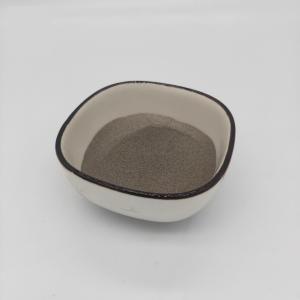
1. Spherical 316L Stainless Steel Powder
Composition (316L): This is an austenitic stainless steel defined by its alloying elements:
- Chromium (Cr): ~16-18% - Provides the fundamental corrosion resistance by forming a passive oxide layer.
- Nickel (Ni): ~10-14% - Stabilizes the austenitic (face-centered cubic) structure, providing toughness, ductility, and formability.
- Molybdenum (Mo): ~2-3% - The key element that significantly enhances resistance to pitting and crevice corrosion, especially in chloride environments.
- Low Carbon (C): < 0.03% - The "L" stands for "Low Carbon," which prevents chromium carbide precipitation during welding or high-temperature processes, preserving corrosion resistance.
Morphology (Spherical):
The powder particles are perfectly round, ball-like shapes. This is achieved primarily through Gas Atomization, where molten 316L steel is disintegrated by a high-velocity stream of inert gas (Argon or Nitrogen).
Advantages of Spherical Shape:
- Excellent Flowability: Particles roll easily over one another, which is critical for automated and consistent powder handling.
- High Packing Density: Spheres pack together more efficiently, leading to higher density in the final sintered product.
- Consistent Melting: In processes like 3D printing, spherical particles melt uniformly under the laser or electron beam.

2. Powder Metallurgy 1000 Mesh
This is the most critical and often misunderstood part of the specification.
"Mesh" Meaning:
"Mesh" refers to the number of openings per linear inch in a sieve screen. A 1000 mesh screen has 1000 openings per inch.
Particle Size Implied by 1000 Mesh:
The nominal aperture size of a 1000 mesh screen is approximately 13-15 microns (µm). Therefore, "1000 mesh" typically implies that the vast majority of the powder particles are finer than 15 µm.
Industry Terminology:
In powder metallurgy, a powder lot is defined by its Particle Size Distribution (PSD), not a single mesh size. A specification of "1000 mesh" is often used to indicate an ultrafine or superfine powder. A more accurate technical description would be a PSD of D50: 5-10 µm or 0-15 µm.
Key Characteristics of This Powder
- Particle Size Distribution: Ultrafine, typically < 15 µm.
- Appearance: Under a microscope, it would appear as a collection of fine, shiny spheres.
- Flowability: Very Poor to Nonexistent. This is a crucial point. While spherical shapes flow well, at this extremely fine size, interparticle forces (Van der Waals forces) dominate gravity. The powder behaves more like a cohesive solid or a fluid than a free-flowing granular material. It is prone to "clumping" and will not flow through a Hall Flowmeter.
- Surface Area: Very high, which makes it highly reactive and susceptible to oxidation if not handled in a controlled atmosphere.
Primary Applications
Due to its ultrafine nature, this powder is not suitable for all powder metallurgy processes. Its primary uses are in highly specialized areas:
Metal Injection Molding (MIM):
This is the most common application. Ultrafine powders are ideal for MIM because:
- They allow for a higher solids loading in the polymer binder feedstock.
- They enable the production of parts with very smooth surface finishes and fine, intricate details.
- They sinter to high density at potentially lower temperatures.
Micro-MIM (μMIM):
A specialized subset of MIM for manufacturing extremely small, precise components for medical devices (e.g., tiny orthopedic anchors, components for minimally invasive surgical tools) and micro-mechanics.
Additive Manufacturing - Binder Jetting:
Some Binder Jetting systems use fine powders to achieve high resolution and smooth surface finishes.
Other Specialized Uses:
- Sintering Activator: Adding a small amount of this ultrafine powder to a coarser powder can enhance sintering and densification.
- Conductive Pastes/Inks: For printed electronics (though less common than silver or copper).
- Surface Coating: For specialized thermal spray applications requiring a very fine feedstock.
Important Note: What It Is NOT Suitable For
Laser Powder Bed Fusion (L-PBF / SLM):
This is the most common 3D printing process for metals. The standard powder size for L-PBF is 15-45 µm or 20-63 µm. A 1000 mesh (<15 µm) powder would not work in a standard L-PBF machine because it would not form a smooth, spreadable layer; it would clump and cause process failures.
Handling and Safety
- Explosion Hazard: Ultrafine metal powders have a very large surface area and are highly explosive when suspended in air. Processing requires explosion-proof equipment and inert atmospheres.
- Health Hazard: Inhalation of fine particles is a serious health risk. Operations must be conducted within controlled environments like gloveboxes or with excellent ventilation and proper respiratory protection.
- Storage: Must be stored in a sealed, moisture-free environment under an inert gas (Argon) to prevent oxidation and pyrophoric reactions.